
 By


How Oil Export Charges Should Be Calculated, Published and Audited
Clear rates, transparent formulas and traceable payments can help strengthen accountability in oil-export transactions.
An oil-export charge may appear as a single figure, yet that figure can raise more questions than it answers. Without a clear unit, calculation method and legal basis, the public cannot independently verify the amount collected.
For example, a rate of 0.3 means little on its own. Does it represent 0.3 per cent of export value or US$0.30 per barrel? The difference matters, especially when charges apply to millions of barrels.
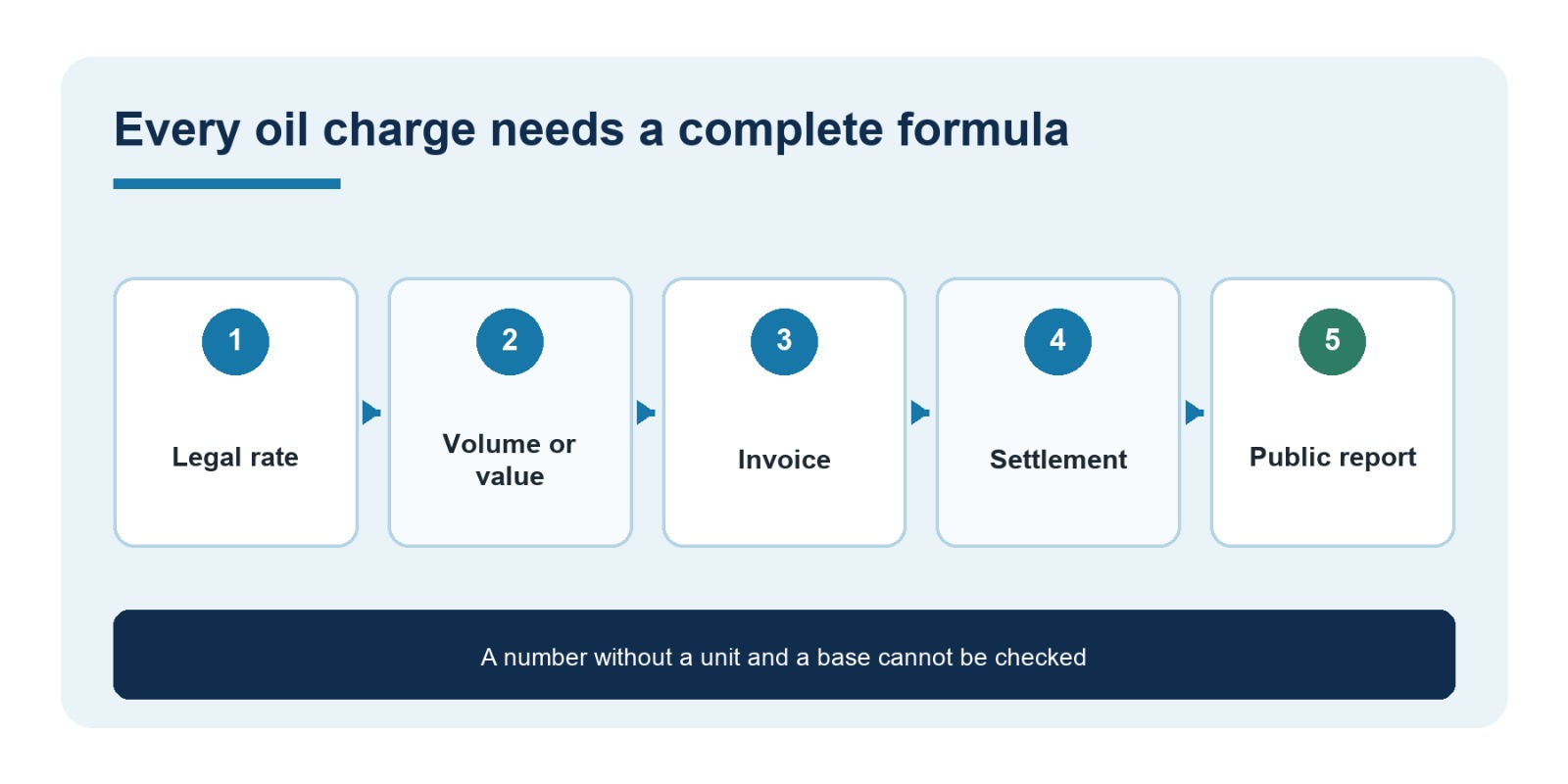
Therefore, governments, operators and service providers should publish enough information for anyone to reproduce the calculation. Each charge should link the shipment record, approved formula, invoice, payment and public account.
Establish the Legal Basis
Before calculating a charge, the responsible authority must explain who approved it and under what legal instrument.
The disclosure should identify the relevant law, regulation, contract or administrative decision. It should also state the effective date, services covered and institution responsible for the revenue.
If a charge covers inspection, accreditation, certification, security or technology services, the notice should explain what triggers the payment and who must pay.
A supplier may calculate or collect an approved amount. However, the authority to impose a public charge must come from the appropriate legal framework. A commercial contract should not replace a legal instrument where national law requires one.
Publish the Rate and Calculation Formula
A transparent fee notice should state five essential details:
- Rate: The exact amount or percentage charged.
- Unit: Whether the charge applies per barrel, shipment or another measure.
- Calculation base: The volume or value used to determine the payment.
- Currency: The currency used and any applicable conversion rules.
- Accounting period: The period covered by the assessment and reporting.
For a percentage-based charge, the notice should identify the export value used and when that value is measured. Similarly, a per-barrel charge should specify the recognized volume and how adjustments are treated.
In addition, the notice should provide a worked example using clearly labelled illustrative figures. This allows readers to check the arithmetic and identify errors involving decimal points, percentages or units.
How Oil Export Charges Should Be Calculated, Published and Audited
Separate Service Charges from Oil Revenue
An oil-export service charge is not the same as the value of the oil itself. Consequently, accounting records should distinguish the two.
Each invoice should show the export quantity or value, the applicable charge, any tax on that charge and the total payable.
The public revenue report should then explain how the money is handled. For example, it should state whether the charge goes to government, pays a service provider, is shared under a contract or follows another approved arrangement.
Crawford Capital’s e-Crude accreditation project page describes a technology and accreditation function. However, the company’s project description alone does not establish the authoritative rate or prove that a particular payment was received.
Those details require supporting documents, including the relevant government instrument, invoices, bank records and public accounts.
Link Every Charge to an Export Record
An auditable system should connect each charge to a verifiable export event. This could include a shipment, cargo, certificate, customs reference or invoice number.
The same reference should appear on the assessment, payment, settlement and accounting records. As a result, auditors can trace a charge from the original transaction to the final account.
This does not mean every commercially sensitive cargo detail must become public. Instead, authorities can publish aggregate figures showing export volumes, charges assessed, collections, refunds and outstanding differences.
The system should also prevent duplicate charges. When an adjustment becomes necessary, the records should preserve the original calculation and link it to the new entry.
Reconcile Payments with Independent Records
A reliable audit should compare the technology platform against independent records, including bank settlements and official production or export data.
If the figures differ, the responsible institution should explain the discrepancy. The reconciliation should also examine reporting dates, currency conversions, exemptions, credit notes, refunds and manual adjustments.
Furthermore, large or unusual adjustments should receive additional review and approval.
The International Monetary Fund’s Fiscal Transparency Code emphasises comprehensive, clear, reliable, timely and relevant fiscal reporting. It also addresses resource-revenue management, recognising the public risks associated with extractive-sector finances.
What Should the Public Disclosure Include?
A one-page monthly disclosure could make oil-export charges easier to understand and verify. It should include:
- The legal authority and current rate.
- The unit, calculation base and worked example.
- The chargeable export volume or value.
- The total amount assessed.
- Collections, refunds and adjustments.
- Authorised recipients and settlement totals.
- Unresolved reconciliation differences.
- Service-performance measures, including processing times, certificates issued and system availability.
The disclosure should also show its review date and link to the underlying public documents. When a rate changes, the previous version should remain available so historical transactions can be checked against the rules that applied at the time.
Transparency Makes Charges Verifiable
Debate over oil-export charges is inevitable. The sector involves public resources, substantial financial flows and complex contractual arrangements.
Nevertheless, disagreement becomes more productive when all parties can refer to the same rate, unit, period and supporting records.
Ultimately, a charge should be more than a figure on an invoice. Its legal basis, calculation and settlement should be traceable from the original export event to the final account.
Precision is not simply a matter of public communication. It is a fundamental control that allows an oil-export charge to be independently tested.
















Comments