
 By
By 
Kenya Bets Big on Blue Economy to Unlock Jobs, Growth and Coastal Prosperity
Kenya is turning to its waters to power the next phase of economic growth.
From the shores of Lake Victoria to the Indian Ocean coastline, the government is scaling up investments in fisheries, aquaculture, and maritime infrastructure. The ambition is bold: transform the blue economy into a major driver of jobs, exports, and inclusive development.
At a time when traditional sectors face pressure, Kenya is betting that its vast water resources can unlock new opportunities especially for youth and coastal communities.
Billions Flow into Lake Victoria to Boost Livelihoods
A significant share of the investment is flowing inland.
The government has committed KSh 9.5 billion to upgrade fish landing sites, markets, and piers across Busia, Siaya, Kisumu, Homa Bay, and Migori counties. These improvements will modernise the fisheries value chain and reduce post-harvest losses.
For many communities around Lake Victoria, fishing is more than a livelihood—it is a way of life. However, outdated infrastructure has long limited earnings.
Now, with better storage, handling, and market access, fishers are expected to earn more while supplying higher-quality produce to local and export markets.
Coastal Projects Open a New Frontier
Meanwhile, along the coast, large-scale projects are reshaping Kenya’s maritime potential.
The KSh 2.7 billion Shimoni Fish Port is set to boost deep-sea fishing and expand export capacity. At the same time, the Liwatoni Fishing Port is enhancing fish handling and logistics.
In addition, a new National Mariculture Resource and Training Centre is taking shape in Kwale County. Once complete, it is expected to be the largest in East Africa.
The centre will focus on seaweed and mangrove farming two sectors gaining global attention for their economic value and environmental benefits. For coastal communities, this opens up new income streams beyond traditional fishing.
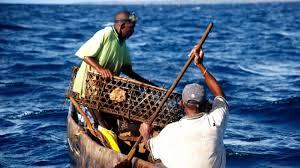
Blue Economy Push to Drive Kenya’s Growth
Funding and Skills to Support Growth
To ensure small-scale players are not left behind, the government has disbursed over KSh 3.2 billion to fisherfolk through Beach Management Units.
This funding is already helping fishers access better equipment and expand operations. As a result, productivity is improving, and incomes are gradually rising.
At the same time, Kenya is investing in skills.
A new maritime technology curriculum is being introduced in schools. This move aims to prepare young people for careers in shipping, fisheries, and marine services.
Together, these efforts are building both the financial and human capital needed to sustain long-term growth.
A Sector with Big Ambitions
Currently, the blue economy contributes between 2.5% and 3.5% to Kenya’s GDP.
However, the government wants to push this to 10% in the coming years. To get there, it is focusing on value addition, sustainable practices, and stronger regional trade links.
Kenya will also host the Our Ocean Conference 2026 in June. The event is expected to attract global investors and position the country as a leader in sustainable ocean management.
Youth at the Centre of the Opportunity
Importantly, the blue economy is emerging as a solution to unemployment.
Young people are being encouraged to explore aquaculture, seaweed farming, and maritime services. These sectors require relatively low capital but offer strong growth potential.
For many, this shift could mean moving from job-seeking to entrepreneurship.
Linking Blue Economy to Tourism and Sustainability
The push into the blue economy also ties into Kenya’s broader sustainability and tourism agenda.
Healthy marine ecosystems support tourism, fisheries, and coastal livelihoods. Therefore, protecting these resources is no longer optional it is economic strategy.
Tourism Cabinet Secretary Rebecca Miano has emphasised the need for inclusive and sustainable growth.
“Tourism must uplift Kenyan lives across all regions and income levels. Our strategies are anchored on inclusivity, sustainability and innovation,” she said.
Her remarks reflect a growing recognition that sectors like tourism and the blue economy are deeply interconnected.
A New Growth Engine Takes Shape
Kenya’s blue economy push signals a shift in how the country views its natural resources.
Rather than seeing lakes and oceans as passive assets, the government is positioning them as engines of growth.
If the current investments deliver, the impact could be far-reaching. Coastal towns could evolve into industrial hubs. Inland fishing communities could see rising incomes. And thousands of young people could find new opportunities.
For now, the momentum is building and Kenya is making it clear that its future growth will not just come from the land, but also from the water.















Comments