
From supporting more than 1.4 million jobs to expanding access to education and digital healthcare, Safaricom’s 2026 Sustainable Business Report highlights the growing role of business in Kenya’s social and economic development.
A mobile money agent in a rural trading centre, a supplier supporting a telecommunications network, a young person pursuing an education scholarship and a patient accessing healthcare through digital systems may appear to have little in common.
Yet each represents a different way in which business activity can influence everyday life.
This wider connection between commercial operations and social progress is at the centre of Safaricom’s 2026 Sustainable Business Report. The report estimates that the company generated KSh1.247 trillion in value for Kenyan society during the financial year ended March 2026.
The figure represents a 10% increase from KSh1.133 trillion reported in the previous financial year. It also reflects a growing economic footprint that extends beyond mobile connectivity and financial services into employment, education, healthcare and community investment.
For a company whose services have become part of everyday transactions, the report provides a picture of how its operations connect with livelihoods and essential services across the country.
The Economic Value Behind Everyday Business
Safaricom’s contribution to Kenya’s economy extends beyond its direct workforce and financial performance.
Its operations support a wider network of suppliers, contractors, dealers, M-PESA agents and business partners. These relationships create economic activity through procurement, infrastructure investment, service delivery and household spending.
According to the report, the company’s activities sustained more than 1.4 million jobs and livelihoods during FY2026.
The figure includes employment supported directly and indirectly through its business ecosystem, as well as induced employment generated when workers and suppliers spend their earnings in the wider economy. It is therefore a modelled measure of employment impact, rather than a count of people directly employed by Safaricom.
For small businesses, this ecosystem creates opportunities to participate in the digital economy. M-PESA agents provide transaction services within their communities, while merchants use digital payments to receive money and serve customers.
The platform also supports access to financial services. Safaricom estimates that M-PESA generated KSh478.1 billion in social value during the year. This reflects benefits associated with financial inclusion, affordable transactions, time savings and access to financial services.
More than half of M-PESA transaction volumes attracted no customer charge during the reporting period, according to the company. This has implications for individuals and businesses that rely on frequent, low-value transactions.
For a small trader, reducing the cost and time involved in receiving payments can make daily operations easier. For customers, digital services provide additional ways to transact, save and access credit.
These everyday interactions help explain why the company’s economic footprint extends well beyond its reported revenues.
Education Investment and the Next Generation
Economic growth also depends on the opportunities available to young people.
Through its Citizens of the Future programme, Safaricom has set targets to build or refurbish 500 schools, award 10,000 scholarships and equip 56,000 teachers with digital skills.
The programme seeks to improve learning environments while preparing students and teachers for an increasingly digital economy.
Its reach is already taking shape across the country. By the time of the report, the initiative was underway in 131 education facilities across 46 counties. Seven facilities were expected to be completed by the end of 2026, while 65 were under construction and 28 remained in planning.
The scholarship component also extends beyond school fees. The support includes mentorship, psychosocial assistance and digital learning opportunities.
These interventions matter because access to education involves more than enrolling a child in school. Learning environments, teaching resources, technology and continued support all influence a student’s ability to progress.
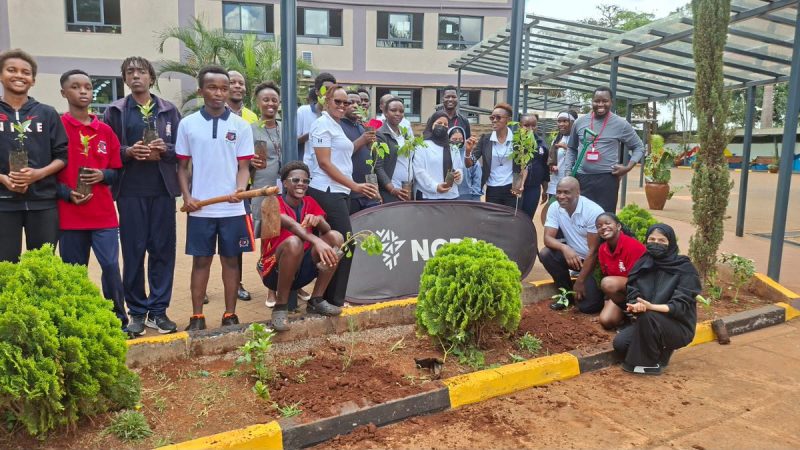
Safaricom and M-PESA Foundation programmes reached more than 4.4 million people during FY2026 across education, health, economic empowerment, water and environmental conservation.
The foundations invested KSh10.2 billion across all 47 counties during the year, according to the report.
The wider ambition is to ensure that community investment creates opportunities that can extend beyond individual beneficiaries and contribute to stronger communities.
Connecting Technology to Healthcare Access
Healthcare is another area where Safaricom’s digital infrastructure is increasingly intersecting with public services.
Through its involvement in Kenya’s digital health infrastructure, the company is supporting systems designed to improve patient identification, information management and emergency response.
The report’s associated corporate disclosures indicate that biometric authentication had registered more than 29.7 million citizens. The national Health Information Exchange supports the movement of health records between authorized systems, while a Health Management Information System operates in more than 6,500 health facilities.
This integration can help health providers identify patients and access relevant information across participating systems. It also supports the broader ambition of improving coordination within the healthcare system.
Safaricom has also supported the Social Health Authority’s National Ambulance Dispatch Centre through an emergency response platform. The system had 892 ambulances onboarded, according to the company’s FY2026 disclosures.
These developments demonstrate how telecommunications infrastructure can support services beyond communication and financial transactions.
For patients, better-connected systems can improve the flow of information between healthcare providers. For health institutions, digital tools can support service coordination and management.
However, the long-term benefits will depend on reliable infrastructure, effective implementation, data protection and the ability of healthcare facilities to use these systems consistently.
Turning Business Growth into Community Opportunity
Safaricom’s impact assessment also highlights the importance of measuring how business activity translates into wider social and economic outcomes.
The KSh1.247 trillion figure comprises KSh654 billion in economic impact, KSh503.6 billion in social value and KSh95.6 billion in financial profit, offset by estimated environmental costs of KSh6.43 billion.
The assessment was conducted by Alexforbes using an impact valuation approach. It is not a measure of cash distributed to households or profit earned by the company. Instead, it attempts to assign monetary values to a broader range of economic, social and environmental effects.
This distinction is important when assessing the role of large businesses in national development. The scale of an organisation’s revenue does not, on its own, explain its contribution to society. Its supply chains, employment links, services and community investments also matter.
Safaricom’s report also marks a shift towards a double materiality approach to sustainability reporting. This considers both how the company affects society and the environment, and how sustainability-related risks and opportunities affect its long-term business performance.
The approach places greater emphasis on accountability, including the need to examine both positive contributions and areas requiring improvement.
The Responsibility That Comes With Scale
Safaricom’s 2026 report presents a picture of a business whose influence increasingly extends into multiple parts of Kenya’s economy.
Its network supports livelihoods, M-PESA facilitates financial transactions, education programmes target future opportunities, and digital systems contribute to healthcare delivery.
Yet the scale of this influence also brings responsibility. The benefits of digital services depend on affordability, reliable access, consumer trust and responsible handling of personal information. Similarly, education and healthcare investments require sustained implementation to deliver lasting results.
The KSh1.247 trillion estimate therefore tells only part of the story. Its real significance lies in the everyday economic and social activities behind the figure, and whether these benefits continue to reach communities.
As Safaricom marks 15 years of sustainability reporting under the theme Rooted in Impact: Connecting the Future, the wider question is how businesses can translate their scale, technology and resources into opportunities that improve people’s lives.
For Kenya, that conversation is increasingly important. The country’s development challenges require more than investment and innovation alone. They also require partnerships that connect economic growth with accessible services, stronger livelihoods and opportunities for future generations.