
KCB Group’s nine-month performance was supported by higher lending, stronger customer deposits, increased transaction income and improved operating efficiency.
KCB Group PLC has reported a 24% increase in profit after tax to KSh58.6 billion for the nine months ended September 30, 2026, supported by growth across its businesses and improved operating efficiency.
The Group’s earnings per share rose by 24.3% to KSh17.8, reflecting stronger earnings during the period.
Its total assets grew by 15.4% to KSh2.4 trillion, driven by a 15% increase in customer deposits to KSh1.8 trillion. Gross loans also rose by 11% to KSh1.4 trillion, reflecting increased lending and customer acquisition.
Total income increased by 12.3% to KSh167.8 billion from KSh149.4 billion a year earlier. The growth came from increased lending activity and higher transaction volumes.
Digital Transactions and Lending Drive Income Growth
Non-funded income rose by 21.8% to KSh54.9 billion, up from KSh45.1 billion. Mobile loan disbursements increased by 26% to KSh492 billion during the period, equivalent to approximately KSh1.8 billion daily.
Foreign exchange income also grew by 65.1%, supported by higher transaction volumes, particularly from Trust Merchant Bank (TMB), and additional services on the Group’s unified mobile application.
These services include money market funds, PesaLink and bill payments.
Meanwhile, funded income increased by 8.2% to KSh112.9 billion from KSh104.3 billion. The Group attributed this growth mainly to higher business volumes, despite a declining interest rate environment.
Operating efficiency also improved. The cost-to-income ratio declined to 43.7% from 46.2% in the same period last year. The improvement reflected stronger revenue growth and prudent cost management.
Total operating costs increased by 6.1%, partly due to technology investments and variable costs linked to business and branch expansion.
Kenya Business and Regional Subsidiaries Support Growth
KCB Bank Kenya maintained its market leadership position, with profit after tax rising by 20.7% to KSh40.8 billion. Its balance sheet grew by 13% to KSh1.6 trillion.
Subsidiaries outside Kenya also recorded strong growth. Their combined profit after tax increased by 24.3% to KSh19.6 billion, supported by performance in Burundi, South Sudan, Uganda and other Group businesses.
These entities contributed 33.4% of the Group’s net profit and 33% of its total balance sheet, highlighting the contribution of regional diversification.
The Group’s non-banking subsidiaries also recorded gains. KCB Investment Bank’s earnings increased by 393.9% to KSh1.1 billion, while KCB Corporate Trustee Services reported a 118.6% rise to KSh258 million. KCB Bancassurance Intermediary recorded profit before tax of KSh471 million.
The three businesses posted combined profit before tax of KSh1.9 billion.
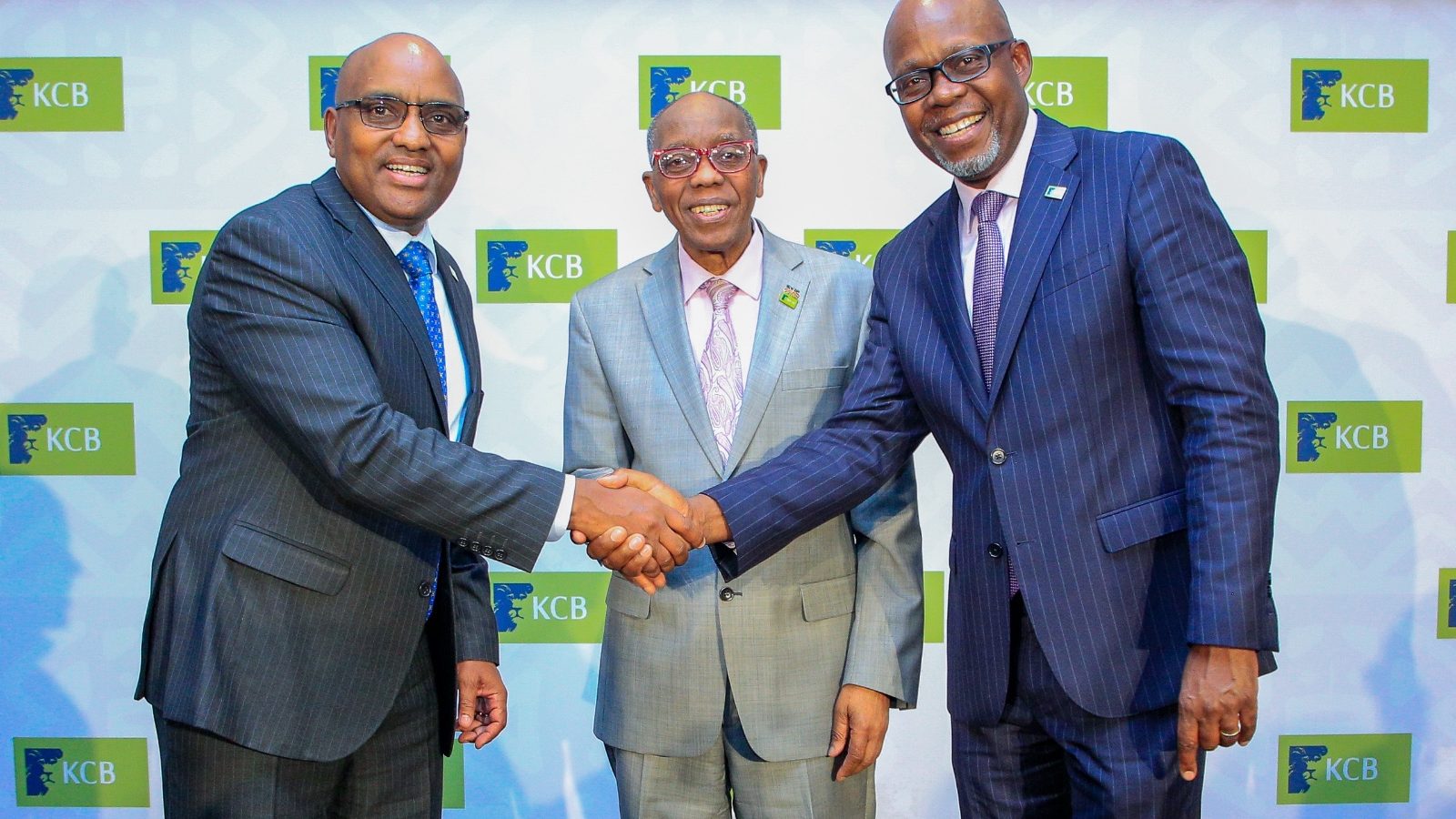
KCB Group CEO Paul Russo said the results reflected the resilience of the business and progress in building a diversified financial services institution.
“Our investments in technology, customer experience and regional business capabilities continue to translate into stronger performance, positioning the Bank for sustained growth,” Russo said.
He added that the Group would use its scale and distribution network to support customers and contribute to economic growth across East Africa. He also highlighted the importance of the micro, small and medium-sized enterprises (MSMEs) sector.
Asset Quality Improves as Lending Expands
The Group reported an improvement in asset quality during the nine-month period.
Gross non-performing loans declined by 17.1% to KSh184.1 billion from KSh222.1 billion a year earlier. Consequently, the non-performing loan ratio fell to 13.3% from 17.8%.
Loan loss provisions also declined by 9.1% to KSh16.6 billion. The cost of risk improved to 1.7% from 2.1% in September 2025.
KCB Bank Kenya recorded a 19.5% reduction in its non-performing loan stock, equivalent to KSh39.3 billion year-on-year.
Meanwhile, lending activity increased across priority sectors, particularly MSMEs. Agriculture, energy and water recorded the highest activity on the overall loan book. Households, real estate and manufacturing accounted for the largest loan components.
The Group maintained a loan-to-deposit ratio of 78.7%, supported by growth in customer deposits.
Green Lending and Regional Expansion
KCB Group also continued to expand its sustainability financing activities. It disbursed KSh20.8 billion in green loans during the third quarter across corporate and retail segments.
In addition, the Group screened loans worth KSh451 billion under its Environmental and Social Due Diligence framework during the first nine months of 2026. The process helps identify and assess environmental and social risks associated with projects financed by the Bank.
In September, KCB increased its shareholding in Trust Merchant Bank in the Democratic Republic of Congo from 85% to 98%. The move strengthens its ownership of the subsidiary and provides greater flexibility to support its growth.
The Group also unveiled its Sustainability Bond Framework in August. The framework lays the groundwork for a planned KSh300 billion Medium Term Note Programme over five years, aimed at mobilising long-term capital for projects with positive environmental and social outcomes.
Strong Capital Position Supports Future Growth
KCB Group Chairman Dr Joseph Kinyua said the Group’s capital buffers provide room to absorb potential economic shocks and support business expansion.
The Group’s core capital to total risk-weighted assets ratio stood at 18%, above the statutory minimum of 10.5%. Its total capital to total risk-weighted assets ratio reached 21.1%, against a regulatory minimum of 14.5%.
Shareholders’ equity increased by 17.3% to KSh362 billion from KSh308.5 billion a year earlier. The Group also recorded a return on equity of 22.1%.
“As we enter the final stretch of the year, our priority is to consolidate the gains we have made while positioning the business for sustainable growth,” Kinyua said.
Beyond its financial performance, KCB Foundation reported that its livelihoods programmes supported more than 55,002 jobs in the first nine months of 2026. The KCB Scholars programme also supported 5,283 students from disadvantaged backgrounds.
The Group said it would continue focusing on customer experience, governance, financial stability and investments that support sustainable growth across its markets.